By Olivia Bautch, ABAS Editorial Chair
If you’re anything like me, you’re not quite satisfied with simply knowing names of species and ticking them off a list. You want to understand; you ask why? Why do they do that? Where did this bird come from? Why does this one look different than the others in the flock?
When I was learning birds, I lived removed from metropolitan amenities, and I didn’t know any other birders until I was in college. It was 2006, birding hadn’t had its glow-up yet. I taught myself the best I could through guides, magazines, and Cornell Lab’s websites. But having hands-on, in-the-field opportunities can be more helpful depending on how you learn.
I’ve been with Amos Butler Audubon Society for three years now—about a year less than I’ve lived in the Indy area—and through this, get to interact with lots of the “professional bird people” in the region. If you’re looking for a community of bird lovers or a location packed with facts and field experiences, I’ll bet I have a suggestion. Here are my top ways to learn about birds in Central Indiana.
Education Centers
We’re spoiled in Central Indiana, with nature centers in almost all of our eight counties. These are usually within a preserve or park, and range in their design, but most have several features in common.
Collections of real feathers, skins, and taxidermy animals are on display or behind glass to study what creatures would typically move too fast or fly away. Eggs and nests might be found preserved in drawers or even integrated into habitat displays around the rooms. These habitat displays are helpful in mentally associating a bird with where you’re likely to observe it, both by location and behavior. Feeder stations or other windows can offer stationary birding.
Other features might be sensory—allowing guests to smell, feel, and listen to nature from indoors—or interactive elements like kids’ toys and puppets, self-serve scavenger hunts, libraries (for kids and adults), or puzzles.
Most internet searches will return with Eagle Creek Ornithology Center as the best regional nature center, but you likely have one closer to you. Making the rounds can be a fun homeschool goal or fill weekends with friends or a date. Here are my top choices by feature:
*The* Bird Destination – Eagle Creek Ornithology Center. Indianapolis, Marion County
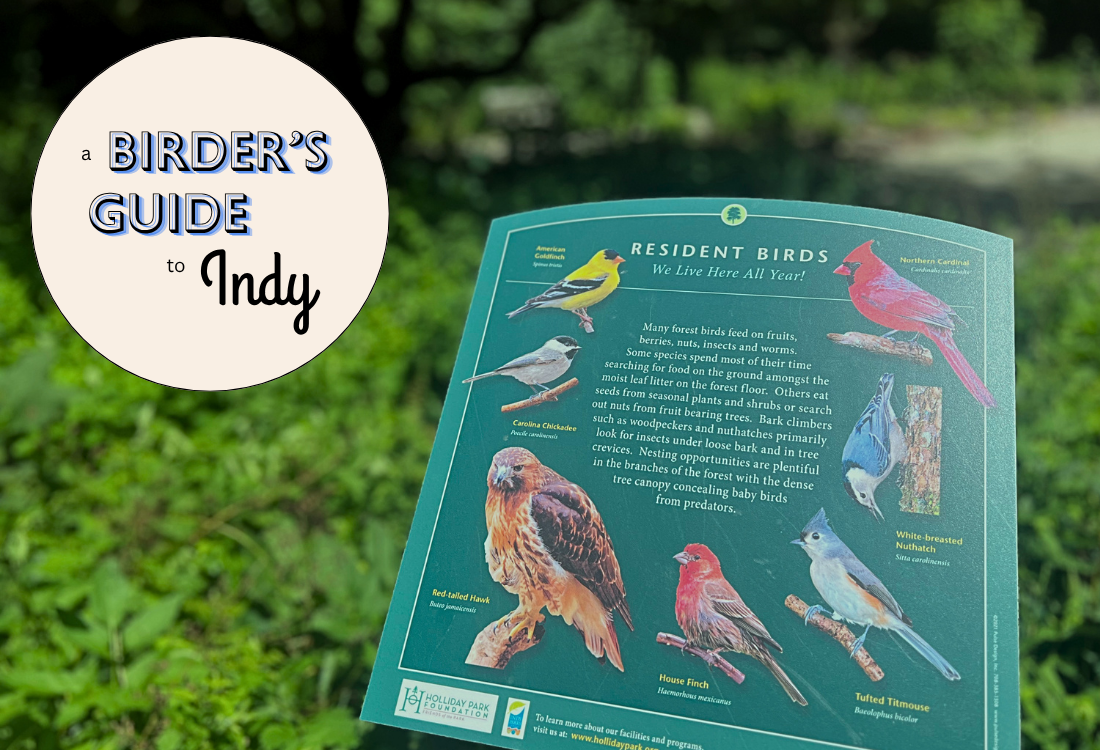
Interactive Features – Holliday Park. Near Meridian Hills, Marion County
Live Animals – Pecar Park Nature Center. Avon, Hendricks County
Zionsville Nature Center. Zionsville, Boone County
Onsite Activities and Crafts – Cool Creek Nature Center. Westfield, Hamilton County
Animal Artifacts – Thornwood Nature Center. Greenfield, Hancock County.
McCloud Nature Park, Grassy Creek Park, Greenwood Stormwater Department, and Strawtown Koteewi Park all have education centers to explore as well.
Groups/Programs
One reason nature centers exist with all of their whimsical props and craft materials is to run educational programs. I understand that not everyone enjoys being part of a group, and many programs do have fees, but this industry is not a lucrative one and ambassador animals need to be cared for; hosting group programs is cost effective. These events may give you access to corners of the center otherwise off-limits or guide you in a skill best learned from an expert.
For instance, bookworms might cozy up to Holliday Park’s book club, creatives try their hand at Hendricks County Parks’ nature journaling or Hamilton County Parks’ art sessions, and analytical minds can survey birds with Carmel Clay Parks and Recreation. Not all programs are hands-on. If a quiet informational talk is more your speed, learn about raptors at Fort Harrison State Park, or learn from Indiana Audubon at one of their community center visits. Though not a nature center, feeder chain Wild Birds Unlimited hosts bluebird and native plant presentations, among other events.
Guided bird walks/outings are catered to a single park or preserve, demographic, or a specific family or even species of birds. Eagle Creek area, Greenfield, Shelbyville, Carmel/Westfield, and Zionsville all have vibrant birding communities with regular outings. You’d be surprised what other locations offer space to learn about birds. Birding is trending, after all, so libraries and general community centers may have an event that suits you.
One note: a good leader (sometimes called a naturalist) will make you a part of the conversation, rather than talking at you or elevating themself. So if one class, walk, or even nature center doesn’t click with you, that’s okay! Find the community that embraces you where you are.
Digital Platforms
Most of us who are picking up a hobby in nature are trying to avoid screen time. But the reality of city life is that not everyone has equal opportunity to visit parks, and honestly, there are some really good resources online. The way I think about internet or social media for birding is as a supplement to your in-person adventures.
For instance, a wealth of information—and probably the most catered to your specific experience—is found on social media (you can’t be serious, right?). When I was growing up we had an email listerv (which I was not allowed to join, ha), and before this there were the 1950s “talking telephone” operators that listed off the latest rarities like a hospital directory. Even then, it was only the highlights.
Currently, information about all bird species, with identification help, and general discussions on ecology, behavior, and birding itself is covered in the Facebook groups Birding in Indiana and its Advanced Birding counterpart. Since about 2023, states have been transitioning to Discord servers for up-do-date information. If you are searching for recent species highlights, you’ll find those here, but eBird is still the most comprehensive reporting platform.
What I like about social media for birding communities is that you’re likely to meet the humans behind the screen and username at parks and neighborhoods. I can’t tell you the number of times I’ll be at a park scouting for a bird that others are reporting in real time on the Indiana Birding Discord, when I run into the users and we enjoy real human connection.
That face-to-face connection is something birding has that gaming and fandoms rarely provide. And when birding is your hobby, you have a chance to make a real difference, just by enjoying it. I’m not just talking about homeowner lawn modifications; these are steps for all. We’ll tell you about it in the next Birder’s Guide.