
By Amanda Kelley
Digital Content Specialist for Hendricks County Soil and Water Conservation District
As an ecology instructor, I spent years tweaking the design of my diversity courses to spark interest early. Do you begin with the earliest forms of life, following an evolutionary storyline? Of course not. If you want to get someone excited about the diversity of life around us, you start with birds.
Birds are the gateway to natural history. Birds are fabulous, and they’re everywhere. They’re constantly drawing attention to themselves with their colors, calls, and song. Birds are lively, always doing something that prompts our curiosity. And the entrance costs to identifying birds are low. You don’t need a microscope, nor do you need to learn a new language of scientific terminology (looking at you, mosses).
You can usually identify local birds with just good observation and straightforward questions. Is the beak straight or hooked? Is the beak narrow or conical? Is the neck held out straight in flight, or curved in an s-shape?
The same things that make birds a gateway taxon also make birdwatching an accessible hobby. However, with over 400 bird species having been found in Indiana, learning to bird can still be daunting.
I became a birder inadvertently after being assigned to run a diversity lab at the University of Alberta that included the birds of North America. When I found myself identifying species I had previously only seen taxidermied, I was hooked. If you want to get into birding but aren’t quite sure how to build your knowledge, this is my best advice.
Bird Where You Are
In my experience, the best place to start birdwatching is wherever you already are. Perhaps you look out into your yard during your morning coffee, sit outside at lunch, or visit the same dog park each evening. Creekside Nature Park in Zionsville is one of my favorite little spots to walk the dog and do some casual birding by the water. It’s easier to develop observational skills when you practice regularly, and incorporating birdwatching into your existing routine helps new habits stick.
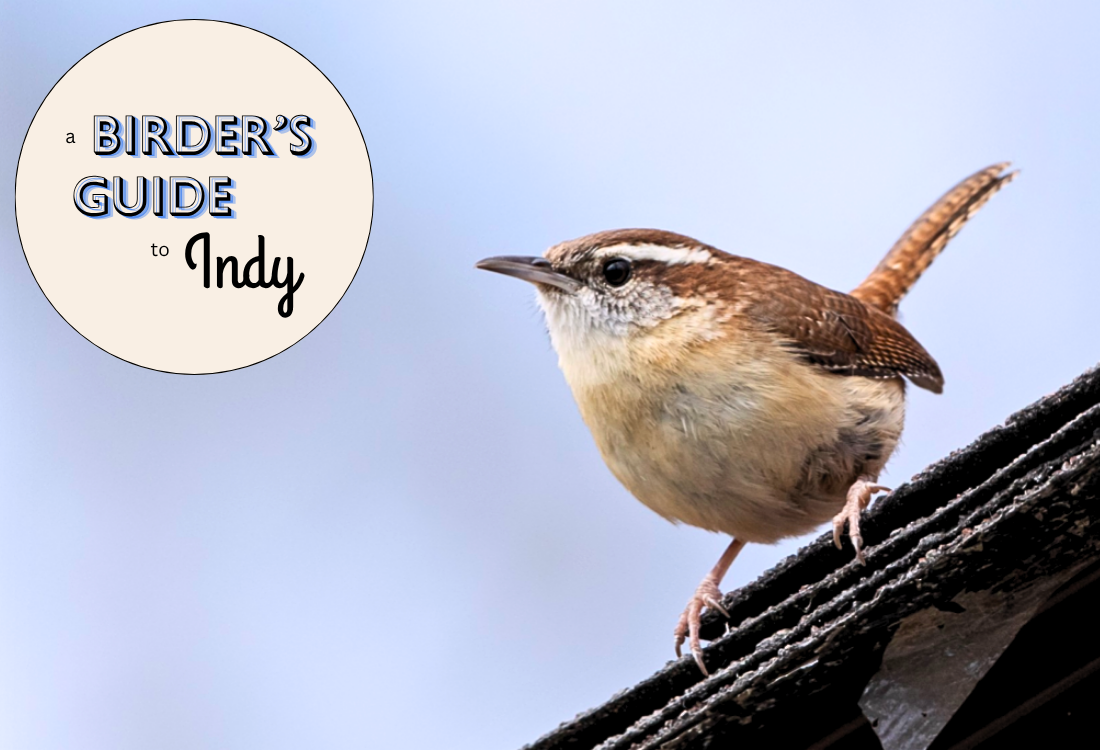
Repeatedly viewing and listening to the same individuals in the same places also helps to build your understanding of the variability within individuals. Perhaps you learn that the Gray Catbird always calls from the top of that spruce. The next time you hear those calls elsewhere, you may not be fooled by the mimic. Carolina Wrens and Northern Cardinals are also famously variable in their vocalizations.
And finally, birding in one place day after day is fun! I like to keep a list of the first day of the year I see each bird species in my yard. It’s a beautiful way to connect with the seasons.
Join Local Bird Hikes
Although it may feel intimidating to join a birding hike when you’re just starting out, it’s actually the perfect time. What you’ll find at these events is a mix of folks at different experience levels who are united by an excitement to learn. Some programs will also have binoculars you can use. And if you don’t know how to use them, plenty of birders will be happy to show you. After teaching for years, I can tell you that most university students do not know how to use binoculars, so there’s no shame in asking for a tutorial!
Many local governments offer birdwatching hikes as part of their free programming. Parks and Recreation departments run both relaxed morning bird walks and larger themed events. For new birders, the Eagle Creek Ornithology Center is a must-visit. Volunteers are happy to nerd out about birds and share their knowledge. At the County level, some Soil and Water Conservation Districts offer programs for birders, from guided walks to workshops on native gardening for birds. It’s worth following your local organizations on social media to see events as they pop up.
Pick Up a Few Tools
Like any hobby, you may feel tempted to buy a lot of gear at the outset. However, there are only a few things I recommend to start:
-
- Merlin Bird ID app– Merlin is a free app developed by Cornell Lab that helps you identify birds using simple questions. You can pair it with their sister app, eBird, to record your birding lists.
- The Sibley Field Guide to Birds of Eastern North America– this field guide is limited in scope, but includes everything found in Indiana. It’s a great resource for learning key ID features.
- A modestly priced pair of binoculars– perhaps after you’ve tried out binoculars on a bird hike, you might pick up a pair of your own. You can get a pair of 10×50 binoculars for around $50. If you decide to get a better pair in the future, you can throw these in the glovebox.
If you really need a second book, I highly recommend The Sibley Guide to Bird Life and Behavior. It provides in depth information by bird family, with lovely illustrations.
Whether you’ve already begun scrutinizing the birds in your backyard, or are starting from scratch, welcome. I hope to see you on the trail!