By Olivia Bautch
Interview with Liz Aguilar, PhD student at IU Bloomington
On April 8, 2024, you probably remember exactly where you were and what you were doing. This, in part due to media hype, was an event (unrelated to motor vehicles) that brought the nation’s focus to our city for a good week.
I settled in as usual to study at a local coffeeshop, and at about a half-hour til 3, migrated to the patio with a dozen other fascinated strangers to await the solar event. Outside I passed the minutes by listening in to conversations like the pair of men beside me who traveled from who-knows-where, but before dark pulled out my phone to contribute my “formidable” birding skills to a new citizen science project.
Nearly two years later, a paper has been published from that project. I spoke with the lead student researcher about the entire process, one that centered on our state.
***
ABAS: Hi Elizabeth, can you first tell us a little about yourself and your part in this study?
Liz: My name is Liz Aguilar, a PhD student in the Evolution, Ecology, and Behavior program at Indiana University Bloomington and a National Science Foundation fellow. I work in Kimberly Rosvall’s lab. [Kim is a] professor in Biology in the College of Arts and Sciences at IU Bloomington.
The foundation of this study began with my involvement in an eclipse workshop series at IU, led by Assistant Dean for Research and Director of Science Outreach, Jo Anne Tracy. It aimed to inform the public about different aspects of the eclipse–from how to safely view it [and] to how to best photograph it, to my topic covering animal responses. Jo Anne attended a meeting of educators wanting to lean into the eclipse. … Someone said, “But what if it’s cloudy?” and remembering my talk, she knew that no matter what, it would get dark and animals would respond.
ABAS: Why did you want to study how an eclipse affects bird life?
Liz: When we realized that a total solar eclipse would peak over Bloomington on an April afternoon…during a critical time for many birds’ only chance at reproduction, it was just too good to pass up. Because the conditions of an eclipse can’t really be recreated in a lab, the eclipse gave us a rare, natural experiment to understand how light shapes behavior in the wild, with implications to learn more about how they cope with rapid environmental change.
Most past research has been anecdotal or focused on a single species. … Those studies showed that animals often respond to sudden darkness, but our work aimed to take the next step by showing this effect quantitatively across wild bird species.
ABAS: What natural or manmade patterns in our environment do solar eclipse events mirror?
Liz: Nothing can truly mirror an eclipse, especially the conditions during totality, but light levels can get quite low on a cloudy day (although the transition isn’t slow and steady like pre- and post-eclipse).
ABAS: So you developed an app that was essentially a unique-circumstance citizen science platform. Tell us about your team’s process of developing this.
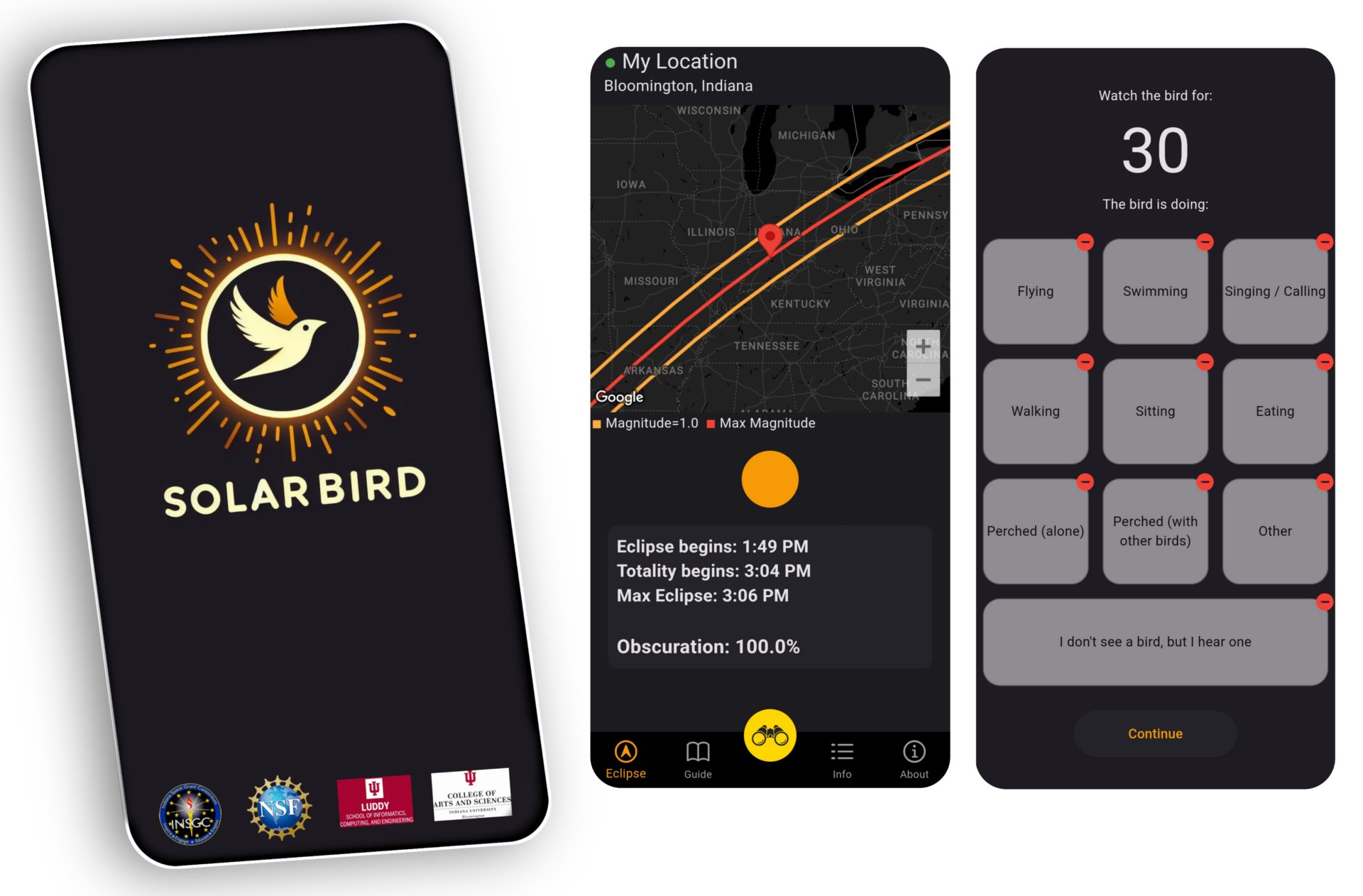
Liz: This project was a large labor of love and even larger collaboration. Community scientists were absolutely essential to this project. The eclipse moved thousands of miles across North America in just a few hours, and our team couldn’t be in all those places at once. So, we joined forces with the public in this process of scientific discovery. By creating our app, SolarBird, we genuinely and actively engaged people in data collection. We wanted the use of SolarBird to enhance the experience of watching the eclipse.
It wasn’t just about looking up at the show in the sky but also taking time to recognize that we were sharing this spectacular moment with nature all around us.
It was very important for me to acknowledge these community scientists as genuine contributors to this work, so those that shared their names in the app are credited in our paper’s supplement. I worked with Paul Macklin, professor of Intelligent Systems Engineering at IU Bloomington and [also] Luddy School undergraduate Ryan Jacobson and master’s student Sean Dixit to create SolarBird. We met weekly for several months, working on an exceptionally fast timeline.
I didn’t have the first clue about creating an app, so they took my vision (literal pencil and paper drawings) and created an amazing app. It came down to the wire, but Sean especially pushed it over the finish line. A bit unexpectedly, Kim and I then did a bunch of media interviews to get the word out.
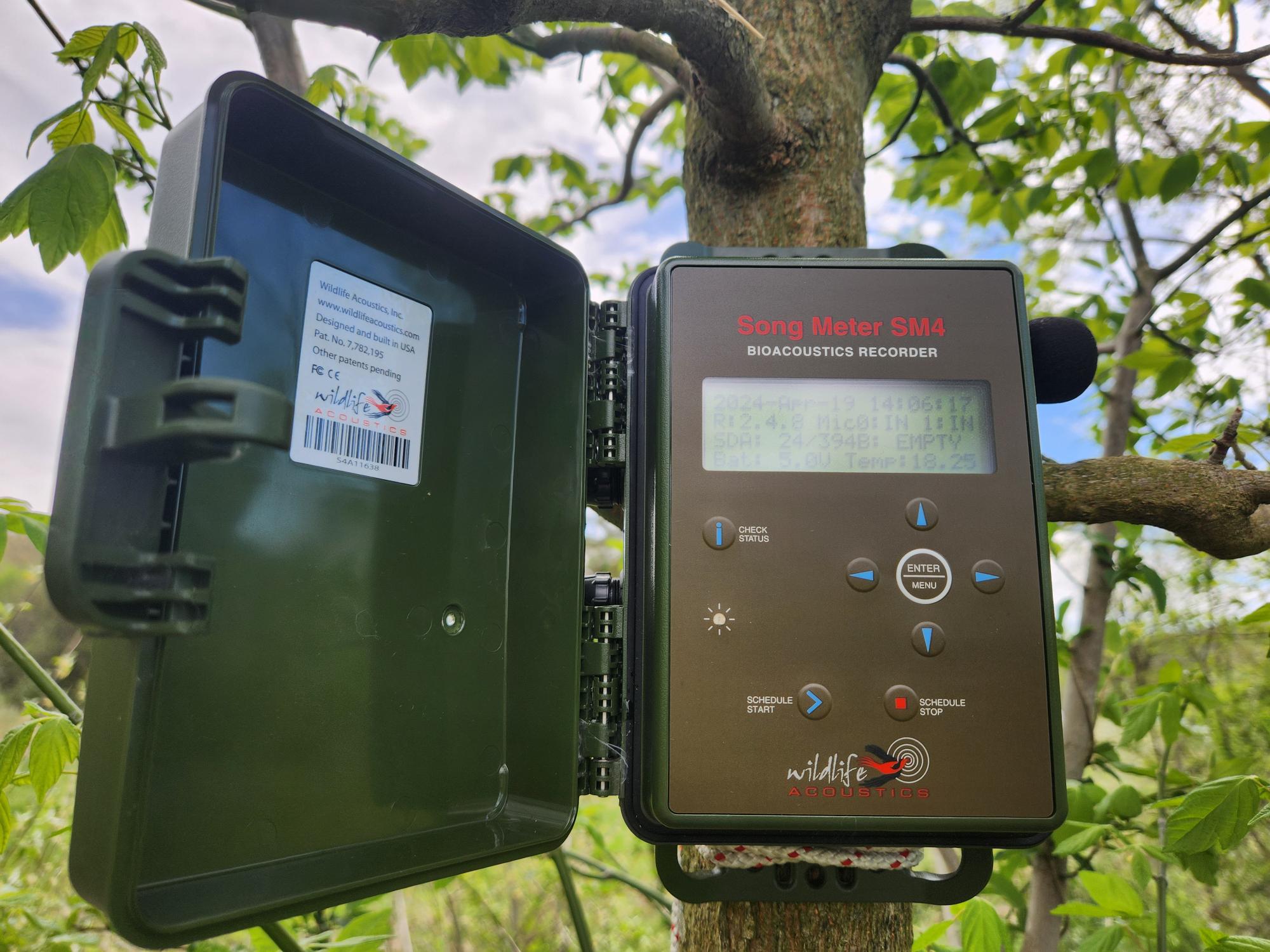
We didn’t know whether people would use the app, so working with Dustin Reichard, faculty at Ohio Wesleyan University, we created a Plan B: automated recorders around Bloomington, collecting data on bird vocalizations before, during, and after totality. We used other days that week as “control” observations… We were able to identify 52 species using BirdNET, and showed it was consistent with what an expert birder recorded for a subset of recordings.
***
Streetlights flashed on to brighten the dull navy skies, quickly closing in on the remaining orange glow above the rooftops. Above golden shop windows, House Finches hurried into the fluorescing signage to roost with their young. Once the frantic rush of wildlife settled down, we on the patio stood to stare at the sun, for a few minutes—five or six—and then the night lifted. Streetlights off; the traffic, chirping, and flight resumed, but this time without the prolonged sunrise of earlier hours. It simply lifted…
ABAS: I was one of the citizens who used the app, so I remember multiple different behaviors one could report a bird engaging in during the observation period. You not only monitored vocalizations, so what insight did you hope to gain from comparing behaviors?
Liz: Thank you so much for using the app! We wanted to capture as many behaviors as we could [and] gather enough observations across the three periods (before, during, after totality) to detect any clear shifts in behavior.
ABAS: You detail your findings in the research paper that was published in the journal Science. Congratulations on that! For our readers, can you summarize the findings in non-science-lit speak?
Liz: Thank you! To have this be my first first-authored publication is an absolute honor.
This study was a huge collaboration that seized a once-in-a-lifetime natural experiment. We leveraged data from two main sources. The first came from the SolarBird app, where nearly 1,700 people submitted more than 11,000 observations across North America. For our core analyses, we focused on [observations in] the path of totality. The second dataset came from 14 autonomous recording units placed around Bloomington [that] captured over 100,000 bird vocalizations, which we analyzed using machine-learning tools.
Observations from SolarBird users showed that birds vocalized more and reduced flying during totality. From our recording analyses, we found that even a four-minute “night” was enough to trigger dawn-like singing in the species that also had a dawn chorus on a normal day. In other words, a very brief disruption in light can cause large changes in behavior, especially for species that naturally produce a burst of song around dawn.
ABAS: Did anything surprise you?
Liz: I was amazed by how many things had to align for this project to happen—the timing, the coordination, even the simple chance of saying yes to one email that set everything in motion. The eclipse happened in April, an incredibly important time for birds in North America. Hearing from participants afterward and seeing how much joy and curiosity this project sparked was the most rewarding part of it all.
ABAS: Did you see a difference between the reactions of native and invasive or “citified”, if you will, species? For example, I’m comparing birds like American Robins and Yellow-throated Warblers to Rock Pigeons, European Starlings, and House Sparrows.
Liz: We looked for patterns among closely related species and also compared migratory versus resident birds, but we didn’t find any consistent differences. It was actually a bit surprising that there weren’t clearer trends, for example, between predators and songbirds or between migrants and locals.
ABAS: What new information does this tell us about birds and their ecosystems? How might this information aid future studies or conservation applications?
Liz: Light is one of the most powerful forces shaping bird behavior, and [the results tell] us just how sensitive some birds are to changes in light. On the flip side, almost half of birds species were insensitive. Taken together, this shows clear implications for issues like light pollution and artificial light at night.
Not all species responded the same way, which could have important consequences for resilience in a brightening world. Knowing which species are most affected could help focus conservation efforts where they’re needed most.
It actually makes sense that not all species reacted the same way. Different bird species greet the dawn in very different ways … We found that species with the most intense dawn choruses were also the ones most likely to react to the eclipse. That pattern suggests that birds most finely tuned to daily changes in light were also the most sensitive to the sudden “new dawn.” It would have been more surprising if every species responded identically.
ABAS: What about the individual behaviors we mentioned before? What did you learn and how might this affect our understanding?
Liz: Users reported the most observations of vocalizing during totality, whereas other behaviors like flying were observed at significantly lower rates. This pattern mirrors behaviors that some species exhibit around sunset. After totality, observations of vocalizing and flying increased.
ABAS: What of your findings, if any, do you and your team see directly impacting work with metro area lighting like that of Indianapolis?
Liz: Although we didn’t see any trends among species, that tells us there’s still more to learn about what makes certain species more or less sensitive to sudden changes in light, which will be an important direction for future research that could impact such work.
ABAS: Do you foresee other uses of this app and citizen science project?
Liz: I do, since this study highlights how combining community science with tools like machine learning can accelerate discovery to uncover how nature responds to both rare events and everyday human-driven changes. It would be amazing to take this work into future eclipses!
ABAS: Finally, what is next for you, in school and in research?
Liz: Even though this work is completely separate from my dissertation—which focuses on individual differences in female aggression in free-living tree swallows—it’s the project I’m most proud of. It showed me how meaningful it can be to connect rigorous science with public participation and shared curiosity about the natural world. As I head into the last year of my graduate program, I’m looking ahead to paths that will allow me to keep science engagement at the center of my career.