November 8, 2026 – IU Indianapolis Campus
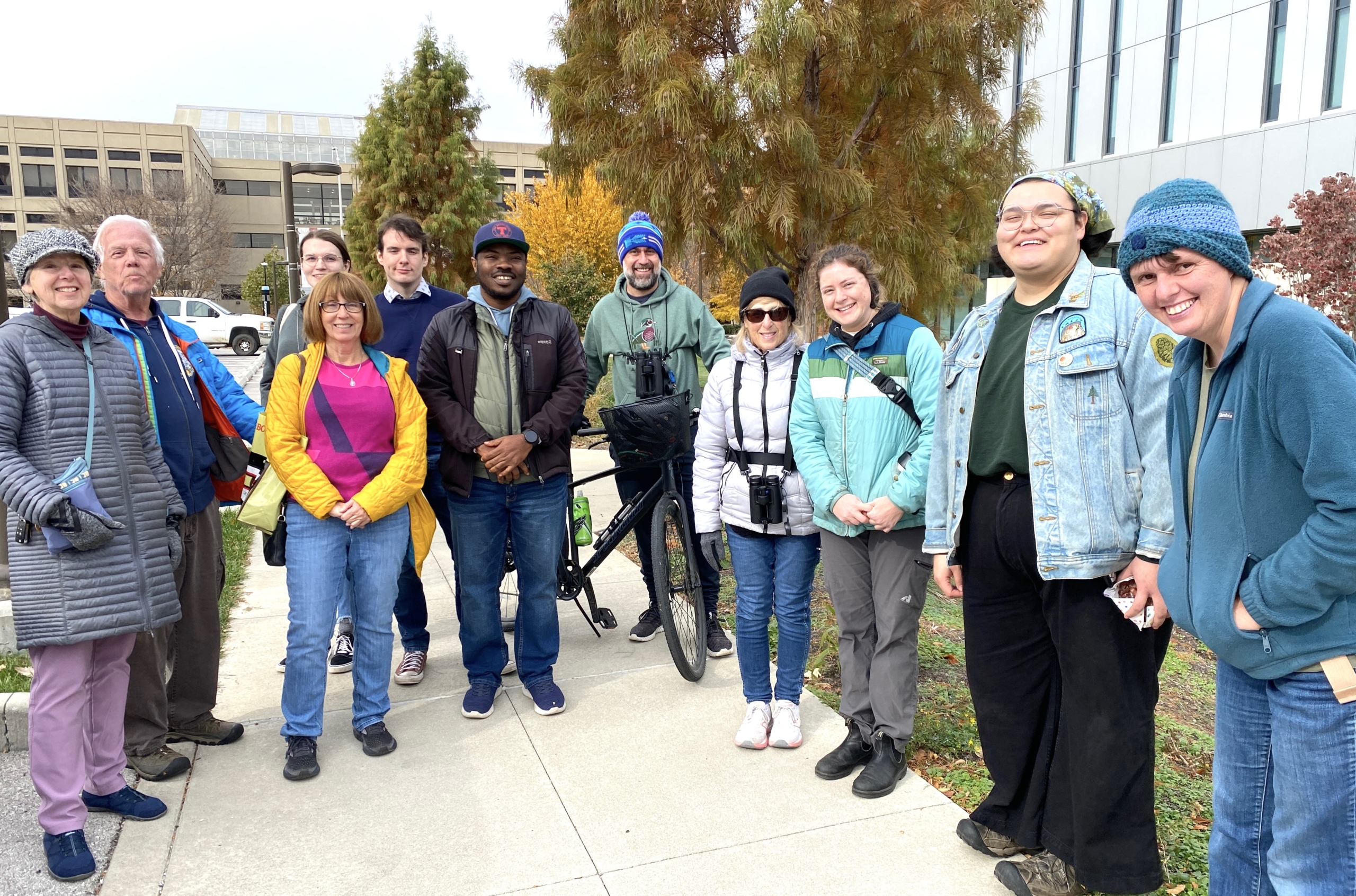
On a cold clear Saturday morning in November, Dr. Victoria Schmalhofer, Assistant Director of the Center for Earth and Environmental Science (CEES), led 12 participants on a fall-break-deserted IU Indianapolis campus bird window strike walkabout.
Dr. Schmalhofer was a 2024 Birdathon grant award winner for her project “Evaluating Bird-Building Collisions on the IU Indianapolis Campus.” This project collected two years of data showing baseline bird-building collisions, involved around 100 faculty, staff, students, and volunteers, raised campus awareness of North American bird declines, shared data with BSI and Global Collision Mapper, trained students in bird identification, and provided research opportunities.
Starting at Innovation Hall (and fueled by local Pana doughnuts), the group spent over two hours observing the majority of the 18 building areas in the survey, with a running informative commentary by Dr. Schmalhofer. The most problematic buildings and areas of these sites and proposed solutions were highlighted.
Walkabout Findings
As an example, it is the south windows of Innovation Hall where most window strikes occur for this building. Three skywalks on campus see a high number and proportion of bird strikes. Indeed, five areas accounted for about 60% of bird-building collisions. The Campus Center with more than four high stories and an all-glass eastern front is a high mortality area. This building also has two upward-directed large lights by the bike rack contributing to the high number of bird window strikes. All in all, just shy of a thousand bird strikes involving approximately 73 species have been recorded in the two-year, 18-building data collection project.
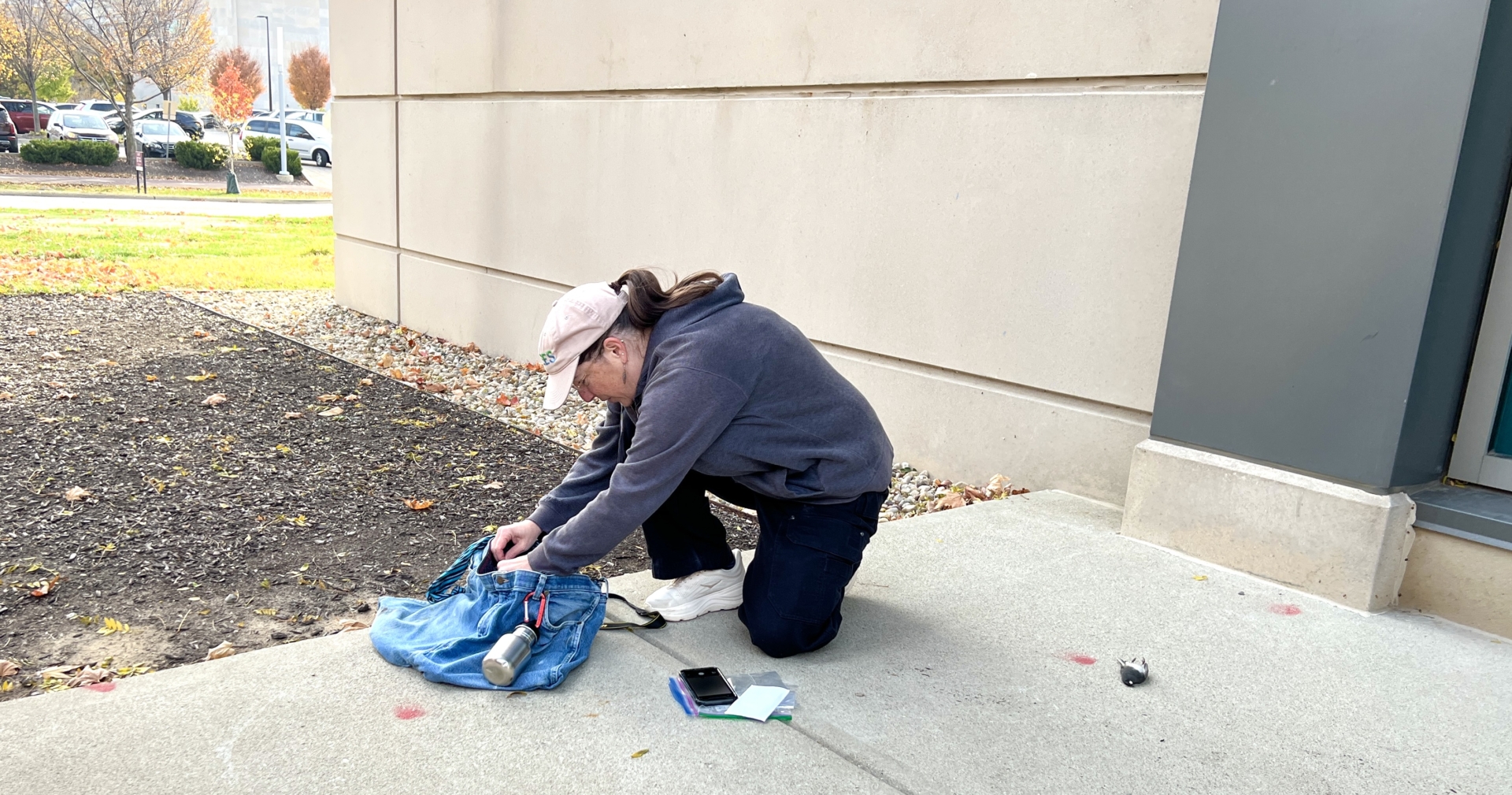
Dr. Schmalhofer demonstrated to the engaged group the “nuts-n-bolts” of data collection when a window strike victim, a Dark-eyed Junco, was found by the north entrance of the IU Robert H. McKinney School of Law. Sobering also was a robin window strike victim in the Courtyard between the residence halls and the Heinz Building.
This walkabout brought home how data collection is critical for specific areas and that there is still much to learn about bird window strikes! Solutions targeted to data collected will likely not only be the most effective, but also the most economical. Strategies being contemplated to reduce window strikes which were identified by this project include: targeted tree removal to remove reflection in part of a skywalk, changing lighting, various forms of window treatments, student-directed art murals, and sound avoidance techniques.
Dr. Schmalhofer’s project summary is in progress and when completed early in 2026 will be brought to the IU Indianapolis Office of Sustainability as well as Campus Facility Services (CFS) and shared with ABAS and Bird Safe Indy. After hoped-for solution implementation, a further study will document any changes from baseline window strikes.
ABAS and BSI stand ready to support this critical initiative in any way possible and are grateful for Dr. Schmalhofer’s initiative, time, and passion!