
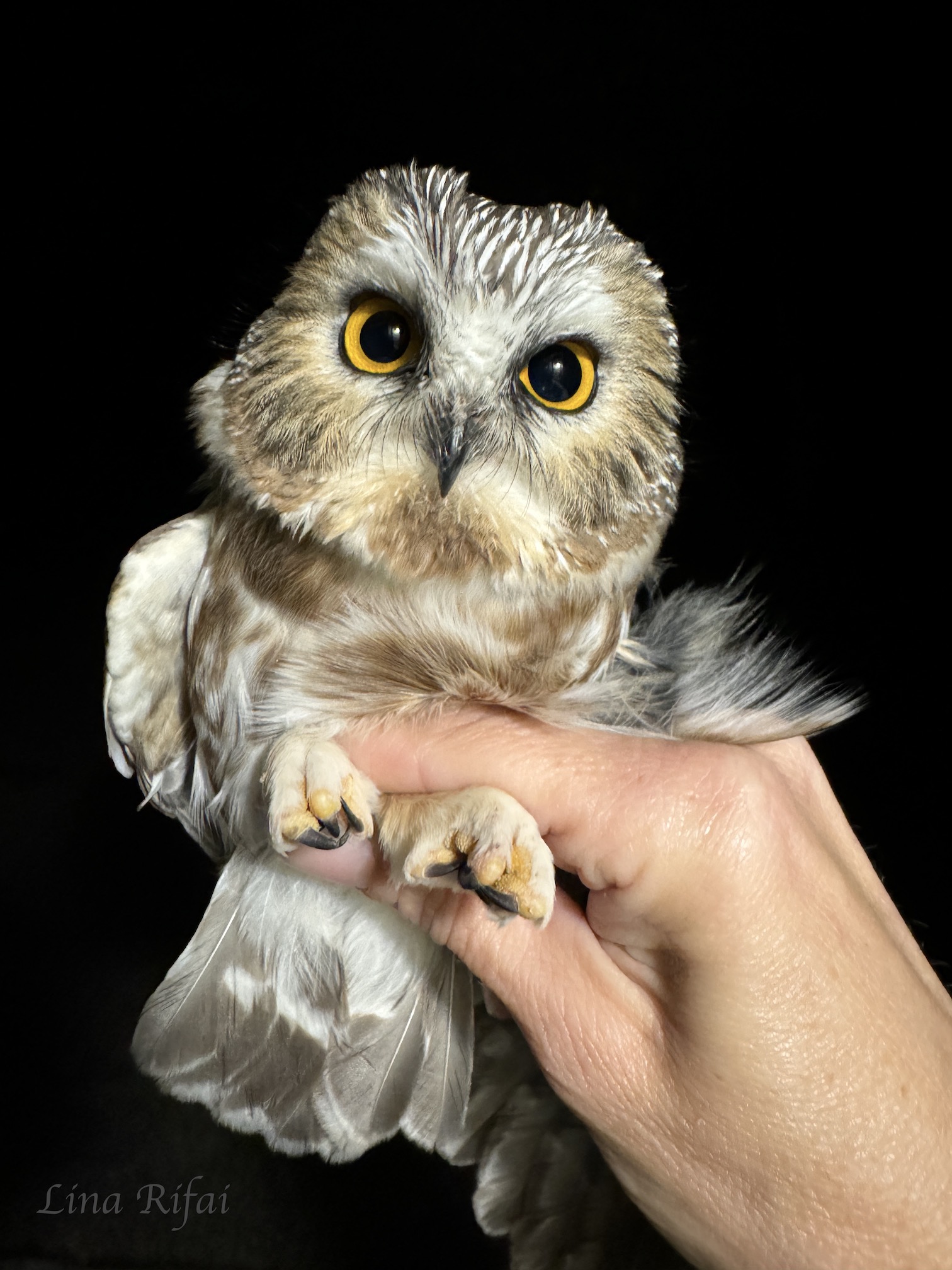
By Lina Rifai, Ph.D., Associate Professor of Vertebrate Biology
School of Sciences, Indiana University Kokomo
Title, Goals, and Objectives of Project: Northern Saw-whet Owl Tracking and Monitoring at Eagle Creek Park
Goals are to gain a…
…better understanding of the timing of migration as well as stopover patterns of Northern Saw-whet Owls (NSWO) using Motus tags to track owls at Eagle Creek Park.
…better understanding of the ecological and biological needs of this owl species in their wintering habitats, with emphasis on urban-type environments.
…better understanding of habitat use in its stopover and wintering habitats in urban regions to be able to provide targeted habitat management.
Goals for 2025/26 season: determining how many of the captured owls remain at the park or its close vicinity after tagging, describing habitat of roost sites, determining diet at the park by collecting pellets, determining last days of departure for spring migration.
Project Completion: This project is ongoing. The 2025/26 season of fall migration and wintering of Northern Saw-whet Owls at the Indianapolis park is the second season for this project. As this was a slow (down) season for these owls a smaller number of owls were able to be outfitted with transmitters than expected, therefore remaining transmitters will be placed on owls that might be caught during their 2026 spring migration (starting in March, which might include a rural site north of Indianapolis). Any remaining transmitters after that will be kept to be used in the 2026/27 fall and winter banding.
Measuring Effectiveness: Effectiveness is measured by successfully tracking and locating owl roosting sites, detecting owls during the night while hunting, collecting pellets at their roosting sites that would otherwise be impossible to find. Recapturing owls during continuing banding sessions and spring migration to assess their body condition, as well as the condition of the transmitter and its attachment, provides further measurements of effectiveness. Another measure of effectiveness is data from detections by Motus stations during the spring migration. More than half of the owls tagged in the last two seasons were successfully tagged and provided migration data as well.
Degree of Attained Goals: I have been able to successfully place about half of the transmitters purchased with the funds for owls during the 2025 fall banding season for owls. Additionally, in February and March of 2025 we were able to complete habitat analyses for roost sites and the results of that portion of the study were presented as part of a Master’s Thesis for Purdue Student Kaitlyn Young. We will add data from this season to provide more data for statistical analyses.
As this year was a lower reproductive success year for Northern Saw-whet Owls at their breeding grounds further north, we captured a higher number of adult owls than in the previous season, which will eventually allow us to analyze differences between ages in terms of habitat selection and diet. Additionally, I have been able to track and locate roost spots for five out of the eight owls with transmitters.
Data on movement between roost places, roost preferences, and pellets are still being collected, but I am currently working on analyzing over 250 owl pellets from last year’s birds. Currently I have collected around 50 pellets from owls tagged in the 2025/26 season. Owls from the 2024/2025 season with Lotek transmitters were all detected at different Motus station as they migrated north in the spring of 2025. Additionally, two owls that were tagged in the previous season were detected returning south in the fall migration season of 2025.
I have been able to detect the presence of every tagged owl at Eagle Creek Park for at least a few days after tagging, which I was not able to do in the previous year. Two owls stayed close to the park for a week, while a third remained in the park area for several weeks before no longer detecting it. Currently four owls are overwintering in the surrounding neighborhoods of the park.
Problems Encountered: Main problem encountered was that this was a year for fewer Northern Saw-whet Owls migrating in the 2025/26 season through our region. This is part of their usual population fluctuations and is not very easy to predict as we must wait for a report from banders in the breeding range of these owls to share information on overall reproductive success of owls that particular year. Although some stations in the northeast had as many owls or more as in the previous season, many of the Project Owlnet stations in the Midwest had much lower numbers, including our station at Eagle Cree Park. However, this might provide a larger number of owls coming through the region in the following season to help increase the amount of data for statistical analysis (e.g. percentage of captured owls overwintering and roost density data). Transmitters not deployed during this season will be used in the 2026/27 season, although once again I will need to find funds to add a few more receivers so we can outfit as many owls as possible in one season and collect more data at one time then.
Weather conditions– as cold, dark nights, with north winds and low wind speeds are ideal for Northern Saw-whet Owl migration, we tend to band mostly on nights that have ideal or near ideal conditions. However, in the 2025/26 season we have had very few days that had the combination of these conditions as compared to previous seasons. Many high wind nights disrupted potential banding opportunities.
Environmental and habitat conditions during tracking proved to be once again harsh on some of the equipment through more difficult terrain and dense vegetation. Although Lotek transmitters have been the better choice for this study, the sensitivity and weight of the equipment needed to track these transmitters can make it very difficult to successfully navigate through the vegetation, and are often very cumbersome. As the equivalent CTT transmitters are slightly heavier, I can only place those on heavier owls and therefore have kept these in reserve for the heaviest owls. A new CTT transmitter technology (using Bluetooth and cellular devices to provide location information even without tracking) is much lighter and if battery life is improved for those, these transmitters will provide much more detailed tracking information and make tracking owls and locating roost spots much easier and more efficient for upcoming seasons.
Owl roost locations have been much more difficult to access this season than in the past season. As of mid-December 2025, all remaining owls that I am tracking have moved outside of park boundaries and are now mostly moving around in neighborhoods on private properties that are difficult to access until I can contact property owners. In some instances, owls have moved to new locations before I can get permission from property owners and confirming exact roosting locations had become more difficult. Other times owls are in areas along major roads, making it more challenging to confirm roosting location and collecting pellets.
Once again, no male owls were captured throughout the season. However, this year more owls of different ages (hatch year, second year, and third year owls) have been caught. It is not unusual to capture less males, however, a few males will be needed to test for any sex-related roost selection sites. Three of the transmitters from this grant are lighter and were purchased specifically for the smaller (and lighter) males. Hopefully in the following season we will finally get a few males.
Excessive deer grazing removed foliage around the main banding lanes, reducing the chance of owls approaching the nets at lower heights within the safety of cover. I added a few more nets at a new close-by site to see increase chances of capturing owls; however, only when enough experienced volunteers (experience in removing owls from nets, helping with net set up and tear down, etc.) were present was I able to use two capture sites at the same time. Until a more consistently dense vegetated area can be located, the main site was still the best option for successful owl capture.
Opportunities for Enhancement: Although not necessary for this project, the presence of a Motus station would provide additional data (I have started the process of gathering all information and resources to help establish a Motus station at the park).
Using CTT’s newest technology transmitters, the Blūbird transmitters with a blū+ extension (Bluetooth technology to connect to cellular devices and with the extension allows me to receive real time location data remotely every few seconds) will need to be added (pending future funding) to test their effectiveness for this study. I have tested this technology on Monarch Butterflies (as they have a version of this transmitter that weighs only 0.06g) and it proved to be highly effective for that study and provide high resolution data. Currently the first leg band version of these transmitters has been released, and once I receive some feedback and reviews from another station that has been testing these transmitters this season, I will know the potential of using that technology in form of leg bands for my project.
Using the GPS-capable transmitters from the same company would still be one of the most effective ways to get a lot of data I cannot get with the current transmitters (such as acceleration information, temperatures, etc.). However, as these transmitters are very expensive (up to $2000 per transmitter) I do not foresee being able to use those unless I can secure a larger grant.
Further research projects using data collected from this project are currently underway with two undergraduate research students at IU Kokomo leading the project. Both students will be spending this entire semester on analyzing movement data and diet data.
This project allowed me to connect with Purdue faculty and students who band these owls in the Lafayette area and hopefully in the future we can extend this study to one of the Purdue properties that provides more data for rural habitats.
Additional Funding/Partnerships Since Initiation of Project: I used funding through the IU Kokomo’s Student Sustainability council (as an Audubon campus chapter) to replace several of the damaged nets from the 2024/25 season and to purchase two additional nets for backup.
Through this project, the partnership established last year with John Schaust has made it possible this year to band on as many nights as we did as well as having someone present who was able to help with placing transmitters on owls. Having someone as experienced and professional as John Schaust to collaborate with made this project as successful as it was able to be in its first year already!
Additionally, I was able to train two new volunteers during the 2025/26 season on net set up and take down and how to safely handle owls to help with transmitter placement on owls.
An amazing group of volunteers from the previous year as well as an additional three more volunteers have been a very consistent and determined group of volunteers.
I was able to provide an owl night experience through this project for my Ornithology class in the Fall of 2025. Students got to experience first-hand field research techniques and how transmitters can be used for animal conservation research. Additionally, through the partnership with the park I was able to invite several Eagle Creek Park staff to the event to share with students their paths to their careers and what kind of jobs are possible for students who want to work with wildlife, conservation, or a similar field. The event was very successful and provided students with a unique experience.
Partnership with Eagle Creek Park has continued to grow, due to an amazing team of staff providing the logistics (ability to access gated area and building to be able to band), support, and help in the field as well. We are hoping to be able to offer a program that includes a potential opportunity for the public to witness the banding process of owls at the park and other educational opportunities.
Progress Report: As much of my progress on this project is already highlighted in the answers above, I will provide as brief overview of accomplishments achieved this season.
I was able to purchase all the necessary tracking equipment with the funds provided through this grant. This included replacement antennas for equipment damaged during the previous season. I purchased a total of 20 transmitters with the remaining funds.
Net sites were set up on October 5, 2025. First banding session was on October 11, 2025. A total of four days were dedicated to setting up, fixing, or maintaining net lanes at net sites.
A total of nine owls were captured (eight owls were banded and fitted with transmitters, one owl was a recapture, an owl that was originally banded near Duluth, MN) between October 11 and December 23, throughout a total of 17 banding sessions within that period. Banding sessions will continue until the end of spring migration.
All eight banded owls received transmitters (Lotek brand). All owls were female. Three of these were hatch years, four second year birds, and one third year bird.
Actively tracking owls started on November 7 and is still in progress. So far at least 23 days of active tracking (minimum of 4 hours per tracking day) throughout the park and surrounding areas, with passive presence/absence tracking on days while banding and during quick visits at the park.
Around 50 pellets have been collected from eight owl roosting sites so far. Vegetation surveys and habitat analysis will start once owls have left roosting areas for spring migration (mid-March to mid-April).
Eight out of eight owls with tags were detected at the park or with handheld receivers for at least an additional 24 hours. Five of these were still detected for at least 30 days after they were initially tagged. Data collection for owl tracking at the park will be continued until the end of spring migration.
Photo by Lina Rifai, Ph.D