
By Mark Welter
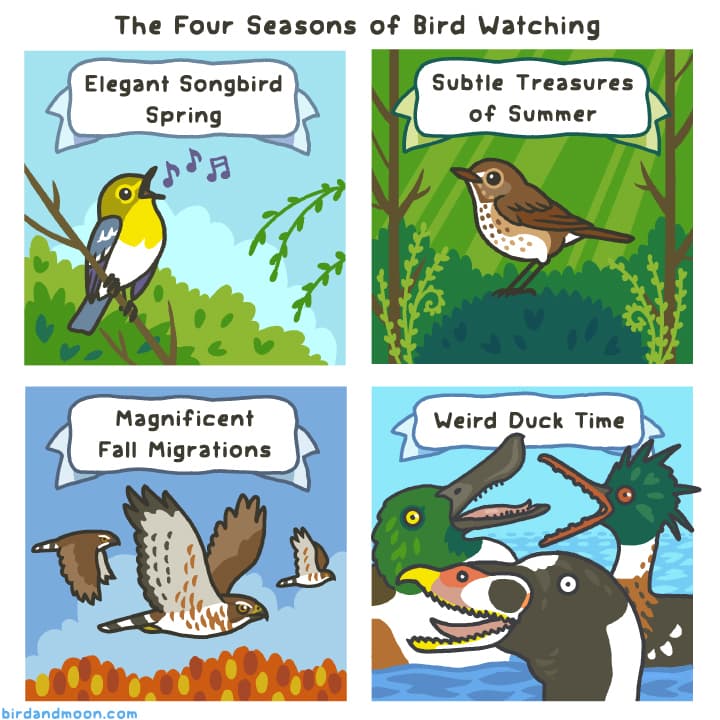
As the days grow shorter, temperatures drop, and the first snow flurries start to fall, many birders’ minds turn not toward the holidays, but toward the season immortalized by the genius cartoonists at Bird and Moon as “Weird Duck Time.” From late October through early March, a unique group of waterfowl consisting of several species can be found in Indiana, either passing through on migration or overwintering in the state.
Collectively referred to as sea ducks (distinct from bay ducks and dabbling ducks), these birds make up some 42 percent of North American duck species. They are all diving ducks, well-adapted for life in a marine environment, as opposed to spending some of their time on land as dabblers tend to do. They breed in northern climates from the high Arctic down through Canada, and winter at lower latitudes. Their relative rarity and visually striking plumages put them high on Hoosier birders’ must-see lists.
Each sea duck species brings its own set of characteristics that make identification both challenging and rewarding. Let’s dive into the details of these fascinating winter visitors you might encounter across Indiana.
Scoters
Black Scoters are medium-sized ducks, but the smallest of the three scoter species. Adult males are jet black with a distinctive bright yellow knob at the base of the bill. Females are brown, with a conspicuous pale throat and cheek, and may present similarly to a Ruddy Duck at distance, complete with a cocked-up tail. Black Scoters, like the other scoter species, winter down the east and west coasts of the US but turn up annually in Indiana, both along Lake Michigan and downstate on large bodies of water like Eagle Creek Reservoir, Geist Reservoir and Lake Monroe.
Surf Scoter is the most colorful of the scoters, with adult males having a black body, brilliant white forehead and hindneck patches, and a huge wedge-shaped orange/yellow/white bill. Females are brown, with a dark cap and smudgy white facial patches.
White-winged Scoter is the largest of the three scoter species, and the one most commonly encountered in Indiana. Adult males are black, with a brilliant white eye patch and a relatively long, flat bill. Females and immature males are brown, with pale loral and cheek patches. The distinctive white secondaries are a key field mark that can be seen in flight, and sometimes while the bird is sitting on the water. If the white secondaries are not evident, female and immature White-wings can be hard to separate from female and immature Surf Scoters at distance.
Mergansers
Common Merganser is a relatively large duck–bigger than a Mallard–that breeds throughout Canada and winters in the Midwestern US, including Indiana, where it can be found on larger bodies of water throughout the state. A handful of breeding records have been documented in Indiana in the past few years, indicating a possible southward expansion of the species’ range. Males have a bright white body, dark back, and a dark green head with a thin red bill that is serrated for holding onto fish. Females have a gray body and chestnut-brown head with a contrasting white chin patch.
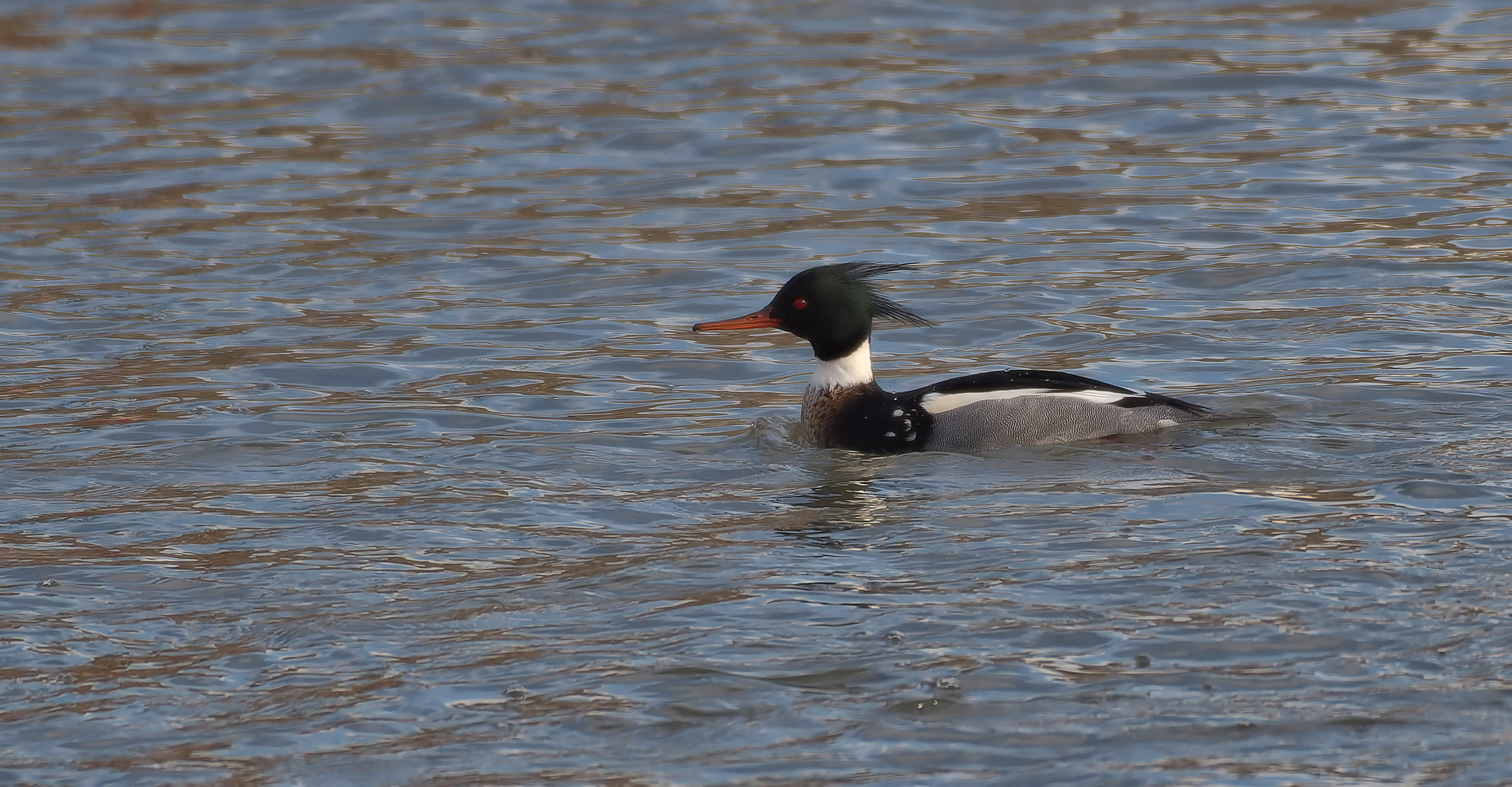
Red-breasted Merganser is similar in size, structure, and habits to Common, but tends to be more widespread in Indiana in winter and occurs in larger flocks which can number into the hundreds at some sites. Males are a patchwork of white, black, gray and brown on the body, with a dark green head topped by a shaggy crest, and a thin, serrated red bill and red eye. Females have a grayish body blending into a reddish-brown neck and head, lacking the clean color separation and white chin found on the female Common.
Hooded Merganser is a completely different species unrelated to the other two mergansers except in name. It can be found year-round throughout the eastern half of the US. It breeds in Indiana but is much more conspicuous and occurs in larger numbers in the winter, where large flocks can be found on almost any sizable body of water. It is relatively small, about the size of a Wood Duck. Males are tan below with a black back, white breast, and black head with a striking yellow eye and large, brilliant white crest. Females are brown, with a tan crest and yellow bill.
Other Weird Ducks
Common Goldeneye winters throughout the lower 48 states and can be found on just about any decent-sized body of water in Indiana, from large reservoirs to strip-pit lakes to small ponds and marshes. Males have a striking black-and-white body, with an iridescent green head and oval-shaped white cheek patch. They can often be seen in late winter through early spring giving their courtship display, throwing their head back dramatically and pointing their bill at the sky. Females are gray, with a contrasting brown head and yellow bill tip. Both sexes have the bright yellow iris for which the species is named.
Bufflehead is the smallest diving duck in North America. It winters in a loose “W” shaped range in the US, the middle of which includes the entire state of Indiana. Buffleheads can be found on pretty much any body of water, including small wetland areas and neighborhood retention ponds, sometimes gathering in substantial numbers. Males generally present as black above and white below, with a large white patch at the back of the head. However, in good light, the head’s green and purple iridescence is revealed. The female is a less-contrasting gray and black, with a smudgy white cheek patch.
Long-tailed Duck is a relatively uncommon winter visitor to Indiana, with most records being immature birds found as singles or in pairs, usually along the lakefront but occasionally on larger bodies of water downstate. It is a small duck, bigger than a Bufflehead but smaller than a Goldeneye. The adult male’s breeding plumage features a gray and white body and head, with contrasting dark wings and cheek patch, as well as the long tail streamer for which the species is named. Female and immature birds show a dark body, whitish head and neck, and the distinctive dark cheek patch, but lack the long tail.
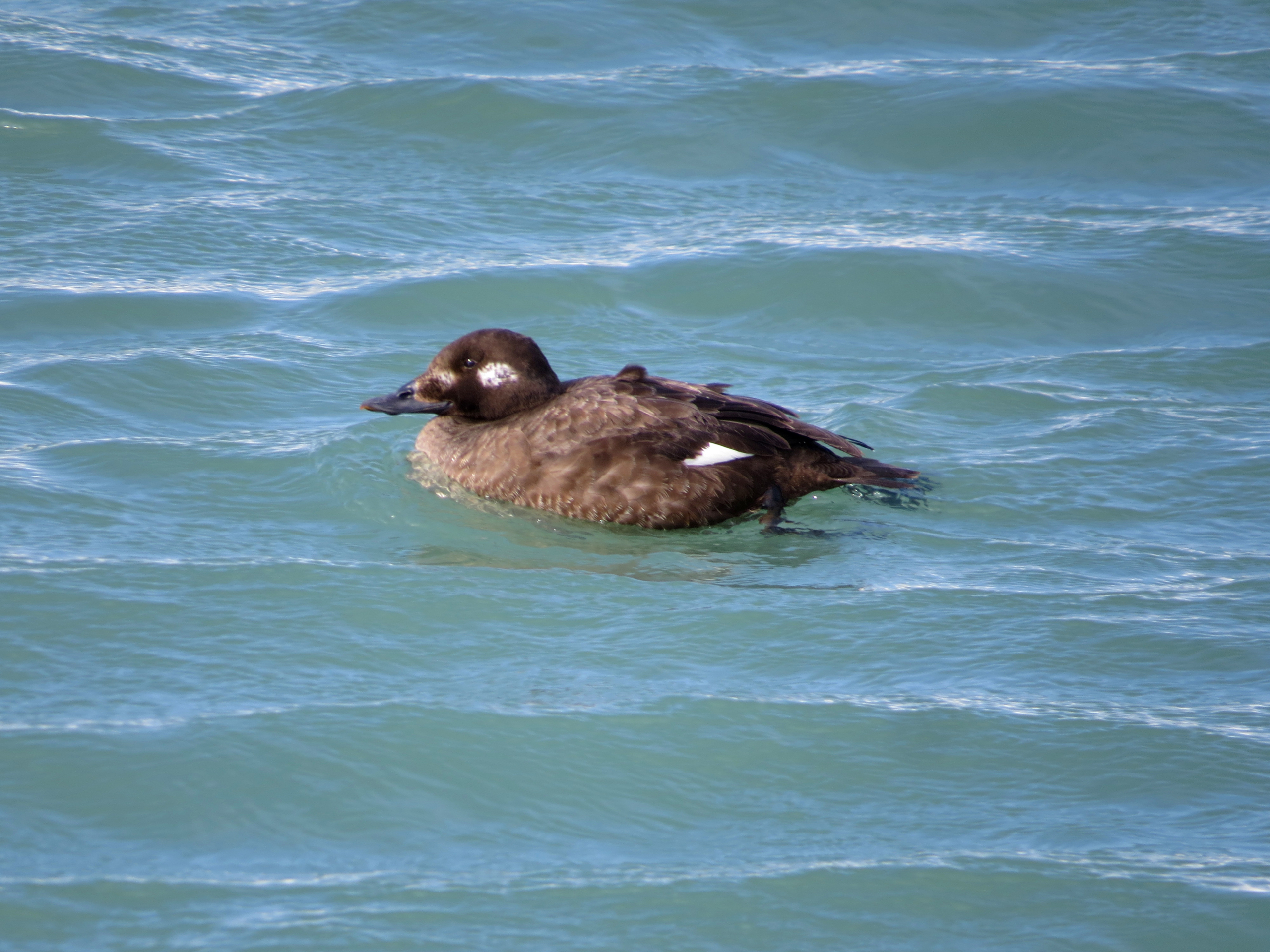
Harlequin Duck is the rarest of the sea ducks regularly seen in Indiana, and as such is the most highly sought after. It almost exclusively occurs along the lakefront, with no downstate records reported on eBird in the past 10 years. The vast majority of reports are single female or immature birds observed from November through January. The adult male Harlequin is an absolute stunner, with a blue-gray body set off with white lines, rusty red flanks and a bright white facial patch. Females are a uniform dark brown with white facial and ear patches.
***
By the time you read this, winter should be in full swing, so get out and embrace the weird by seeking out the awesome and unusual ducks that call Indiana home during the season!
References
The Sea Duck Joint Venture: https://seaduckjv.org/meet-the-sea-ducks/
The World Birds – Sea Ducks: https://theworldbirds.org/HTML/Duck_Sea.htm
USFWS, “Diving Into the Mysterious World of Sea Ducks”: https://www.fws.gov/story/2023-11/diving-mysterious-world-sea-ducks